Chappie Learn: The Solution to AI Abuse in Education 🚫🎓
Many teachers and schools are very concerned about AI tools like ChatGPT. Understandably so, because students often use it to passively copy answers without actually understanding the material. This is a major pain point in modern education and drags down performance.
Chappie Learn was specifically developed to solve this. Instead of spoon-feeding answers, our AI tutor guides the student through active, pedagogical learning methods that align directly with their own textbook. This way, the student really learns to think for themselves!
Students enter their homework question and get the ready-made answer instantly. No learning process takes place, homework becomes a copy-paste task, and students fail on exams.
The AI asks Socratic, guiding questions and gives targeted hints instead of answers. Students are forced to actively apply the theory from their own book to move forward.
Cramming a list of words right before a test feels productive, until you've forgotten half of them a day later. That's precisely the problem. Learning vocabulary with AI isn't interesting because it sounds new, but because it finally aligns with how students truly learn: irregularly, under time pressure, and with material that varies by school, method, and level.
For many students and parents, the frustration is familiar. One app uses standard lists that don't match the lesson. Tutoring sometimes helps, but quickly becomes expensive per month. And self-studying from a book or notebook requires more discipline than most busy school weeks allow. AI doesn't change this by making students work harder, but by organizing studying smarter around the words a student actually needs to know.
Why Learning Vocabulary is Often Unnecessarily Inefficient
The classic approach is simple: read, repeat, quiz, forget, start over. That seems logical, but it's rarely the fastest route to a good result. Not every word is equally difficult, not every student makes the same mistakes, and not every moment of practice yields the same benefit.
This is where many existing learning tools fall short. They treat everyone roughly the same. A student who struggles with verb conjugations often gets the same exercise as someone who primarily confuses nouns. That costs time, and time is precisely what most students lack.
AI can make a difference here by recognizing patterns. Which words are consistently wrong? Which category remains difficult? At what point is repetition needed? This shifts the focus from extensive practice to targeted practice. That's not only more pleasant, but usually more effective too.
Learning Vocabulary with AI Means Learning from Your Own Material
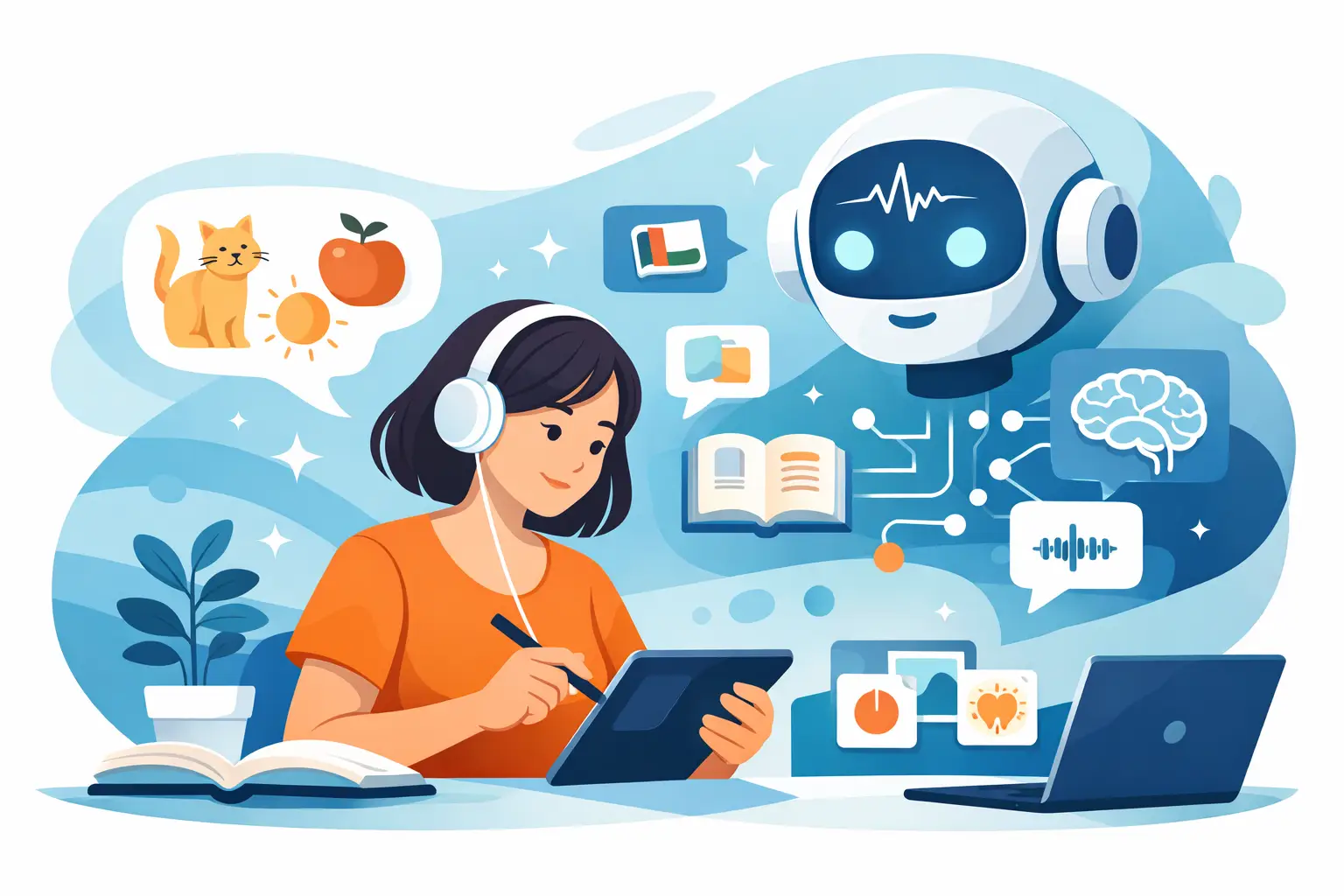
The biggest advantage of learning vocabulary with AI isn't in the word AI itself. The real benefit is personalization. A system that works with a student's own learning material can create exercises that directly align with what will be asked in class tomorrow.
That sounds obvious, but in practice, it makes a big difference. A generic vocabulary app can be useful for extra practice, but often remains detached from the school's method, chapter, or pace. Those who learn from their own summaries, word lists, or chapters work more purposefully. The practice becomes more relevant, and motivation increases because the link to the test is immediately visible.
For parents, this is at least as important. They usually aren't looking for a technically clever solution, but a way for their child to spend less time and still achieve better results. If AI builds exercises based on the material already available, studying feels less like an extra chore and more like a smart extension of the lesson.
No More Starting from Scratch
Many students lose time on preparation. First typing out words, then making flashcards, only then to start learning. AI can largely eliminate this preliminary work. From existing learning material, practice questions, quizzes and revision moments can be created faster. This not only saves time but also lowers the barrier to even begin.
That's an underestimated advantage. Effective studying often fails not due to content, but due to resistance to getting started. If the path between learning material and practice becomes shorter, consistent learning suddenly becomes more realistic.
How AI Better Aligns with What a Student Needs
A good AI approach does more than ask questions and check answers. It looks at behavior and progress. Not in a complicated way, but in a practical one. If a student consistently confuses certain French words, that exercise should reappear. If German cases are already going well, endless repetition is a waste of time.
That makes learning more efficient. Instead of a flat schedule, the student gets a dynamic learning path. Easy words fade into the background faster. Difficult words, however, reappear more often, in new ways and at the right moment.
Repetition When It Counts
Effective vocabulary learning revolves around timing. Repeating too early is not very challenging. Repeating too late often means starting over. AI can help by planning precisely in between. This principle isn't new, but AI makes it easier to apply it consistently and personally.
For students, this means less aimless repetition. For parents, it means more insight into progress without having to quiz their child every evening themselves. For schools, it means that extra support becomes scalable, without needing separate manual exercise sets for every student.
Where Learning Vocabulary with AI is Truly Better Than Traditional Tutoring
Tutoring has value, especially if a student struggles with explanations or motivation. But for learning vocabulary, one-on-one guidance is often an expensive solution for a task that specifically requires frequent, short, and targeted practice. And that's precisely where AI excels.
AI is always available, works based on current material, and can adapt endlessly without extra costs per session. This makes it a logical alternative for families who want results but don't want to be tied to high hourly rates.
That doesn't mean human guidance is never needed. Some students require structure, explanation, or confidence that goes beyond vocabulary practice. But precisely for this reason, it's smart to automate vocabulary learning where possible. Then human attention remains available for the moments when it truly makes a difference.
The Pitfall: AI is Only Good if the Input is Correct
There's also a clear caveat. AI isn't automatically better just because it's AI. If the source is poor, the word list is incomplete, or the context is missing, then the exercises will also be less effective. Personalization only works well if the content is accurate.
That's why an approach based on one's own learning material is so powerful. You reduce the chance of noise and increase the likelihood that practice is directly relevant to school. Especially in secondary education, where methods, levels, and test formats differ per class, this is not a detail but a prerequisite.
Not Every Child Learns the Same Way
Another nuance: not every student wants to practice in the same way. One prefers to learn with quick quiz questions, another with sentences or context. A good AI system should be flexible in this regard. Training only isolated word translations is sometimes fine for a short test, but insufficient if a student also needs to actively use words.
Smart support, therefore, looks not only at speed but also at depth. Do you know the word passively, or can you also apply it? The correct answer depends on the goal. For a quiz, direct recognition is often enough. For speaking proficiency or writing assignments, more is needed.
For Schools and Families, Efficiency Matters Most
Ultimately, the choice of a learning method rarely revolves around technology alone. The question is simple: does it yield better results in less time and at lower costs? For many families, that's the real consideration.
Learning vocabulary with AI fits well into that logic. It reduces reliance on expensive tutoring, makes practice more relevant, and helps students become more independent. Especially when a platform works with a student's own learning material, something emerges that traditional study apps often lack: direct alignment with what's happening at school.
For schools, there's also an opportunity here. Offering extra practice is often desirable, but manually creating customized materials for large groups takes a lot of time. AI can accelerate this translation, without the content becoming detached from the curriculum. This makes support not only smarter but also more realistic within the context of teacher shortages and full schedules.
What a Smart Approach Delivers in Practice
The best results usually come not from longer learning, but from more targeted learning. A student who practices for twenty minutes with words that were wrong yesterday learns more than someone who blindly goes through an entire list for an hour. That's the power of a personalized approach.
Precisely for this reason, a platform like Chappie Learn fits this way of studying so well. Not because it makes learning more complicated, but because it converts existing learning material into something directly usable: personal practice, quick feedback, and less wasted time. That's pleasant for students, more affordable for parents, and more scalable for schools.
Those who need to learn vocabulary usually don't need more study advice. They simply want an approach that works on a busy Wednesday evening, two days before a test, with precisely the words that count at school. If AI organizes that well, learning becomes not only more modern but, above all, much more logical.
And perhaps that is the most useful shift: no longer trying harder, but finally studying in a way that fits what school truly looks like.