
Chappie Learn: The Solution to AI Abuse in Education 🚫🎓
Many teachers and schools are very concerned about AI tools like ChatGPT. Understandably so, because students often use it to passively copy answers without actually understanding the material. This is a major pain point in modern education and drags down performance.
Chappie Learn was specifically developed to solve this. Instead of spoon-feeding answers, our AI tutor guides the student through active, pedagogical learning methods that align directly with their own textbook. This way, the student really learns to think for themselves!
Students enter their homework question and get the ready-made answer instantly. No learning process takes place, homework becomes a copy-paste task, and students fail on exams.
The AI asks Socratic, guiding questions and gives targeted hints instead of answers. Students are forced to actively apply the theory from their own book to move forward.
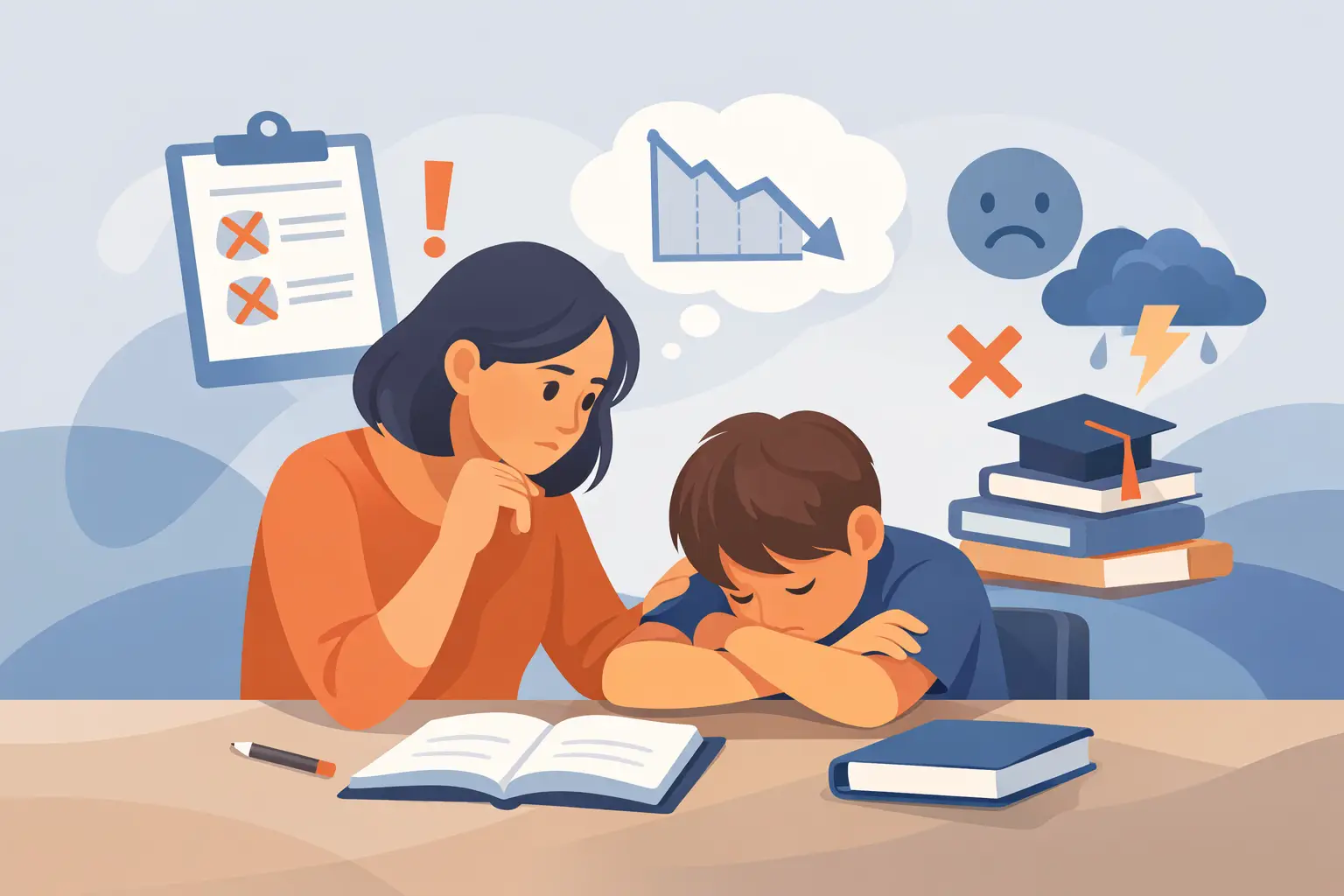
A failing grade on Magister is rarely just a number. For a child, it often feels like stress, shame, or the idea that they "just can't do it." For parents, it usually raises a different question: what to do when your child gets bad grades, without immediately resorting to arguments, pressure, or panic?
The short answer is: first understand, then adjust. Bad grades are usually not a sign of laziness, but of a mismatch between what school demands and how a student currently learns, plans, or receives support. That's precisely where you, as a parent, can make a big difference.
What to do when your child gets bad grades: start without judgment
The initial reaction often determines whether a child remains open to talking or shuts down. If a failing grade immediately leads to anger, punishment, or comparisons with siblings or classmates, the real cause disappears from view. Then you mostly get short answers like "I don't know" or "it doesn't matter."
A calm conversation at a neutral moment works better. Not between dinner and homework, but when there's space. Ask what exactly happened. Was the test unexpectedly difficult? Was there too little time to study? Was the material understood, but applied incorrectly? Or was something else at play, such as fatigue, performance pressure, or issues in class?
That tone matters. A child who feels safe is more likely to honestly say that the chapter was never truly understood, or that they studied for hours but in the wrong way.
Bad grades almost always have a cause
Parents often immediately look for a solution, but without a diagnosis, you can easily miss the mark. Extra practice helps little if planning is the problem. Stricter control is counterproductive if fear of failure is the real impediment.
With disappointing results, you often see a few recurring causes. Some children don't understand the explanations in class well enough and consequently develop gaps in their knowledge. Others understand the material, but learn too passively – they reread summaries, highlight texts, and think that's enough. There are also students who simply start too late, allowing stress to take over. And sometimes the workload is too high: school, sports, social pressure, and screen time all compete for attention.
That's why it helps not to ask: "Why did you get a bad grade?" but rather: "Where did the learning process go wrong?" That's more concrete and less accusatory.
Look for patterns, not just one failing grade
One bad grade doesn't necessarily have to be an alarm signal. A difficult test, a bad day, or an unclear teacher can always happen. More interesting is the pattern. Is it going wrong in one subject, or in several? Are they mainly written tests? Do grades drop mainly during periods with many deadlines? Is there effort, but little return?
That distinction is important. A child who consistently gets low grades in math needs something different from a student who normally performs well but suddenly declines. In the first case, the foundation probably needs to be strengthened. In the second case, you'd look more at motivation, busyness, stress, or changes at home or at school.
Also, the question of whether a child knows exactly what is expected from a test is often underestimated. Many students learn "a lot," but not in a targeted way. They don't know which concepts are central, how the teacher asks questions, or which mistakes keep recurring.
From emotion to action: make it small and concrete
Once the cause becomes clearer, the next step is simple: make improvement small enough to be achievable. Parents often say: "You really need to work harder." That sounds logical, but a child can't do much with that. What is harder? Longer? More often? Smarter?
Concrete works better. For example, agree that for a difficult subject, thirty minutes of active learning will be done four days a week. Or that notes are updated immediately after each lesson. Or that a test is prepared in three short blocks instead of one long evening at the last minute.
A good learning strategy is more important than just making more time. Active learning means that a student quizzes themselves, creates practice questions, analyzes mistakes, and explains difficult parts in their own words. This is often where things go wrong: children spend time, but not in the way that gives the greatest chance of better grades.
What you better not do
Some reactions feel logical, but they make the problem bigger. Punishing without a plan is a good example of this. Taking away a phone can provide temporary peace, but it doesn't solve knowledge gaps or unclear study methods. The same applies to lecturing about "responsibility" without practical support.
Taking over too much also doesn't work. As a parent, checking every homework moment, making summaries, or constantly reminding seems helpful, but it often makes a child dependent. The intention is not for you to organize better, but for your child to learn step-by-step how to do it smarter themselves.
Comparing with other children is perhaps the least effective of all. It rarely motivates and primarily damages self-confidence. A child who already feels insecure will not learn better as a result.
When extra help is indeed useful
Sometimes parental guidance is not enough. Not because you're falling short, but because some learning problems are more specialized or simply require more structure than is feasible at home. Then extra help is sensible, especially if the backlog grows or the tension around school increases.
However, the form of help is important. Traditional tutoring can work, but it's often expensive and not always efficient. Especially if the support remains too general and doesn't align with the exact school material. Then a family pays a lot, while a student still practices material that doesn't quite match what's asked in class.
For many families, personalized, digital study support therefore works better. When a student practices with their own chapters, their own summaries, and their own test material, learning becomes immediately more relevant. That saves time, increases focus, and makes it easier to work precisely on what hasn't been mastered yet. A platform like Chappie Learn logically fits this, as it converts study material into personal practice instead of offering generic tutoring.
What to do when your child gets bad grades in secondary school
In secondary school, two things often happen simultaneously: the content becomes more difficult, and independence needs to increase. Precisely that combination causes friction. A first-year secondary student might still be looking for a rhythm, while an upper-year student struggles with pace, test pressure, and large amounts of material.
That's why it's smart not only to look at grades but also at study skills. Can your child plan? Do they know how to break down a large chapter? Is there insight into mistakes from previous tests? Are difficult subjects tackled in time, or only when the deadline approaches?
Whoever gets a grip on that usually sees results fairly quickly. Not always spectacular leaps immediately, but more calm, less procrastination, and a clearer sense of control. And that is often precisely the foundation upon which grades can recover.
When bad grades are a sign of something bigger
Sometimes bad results aren't just about learning. If a child suddenly declines, becomes easily irritated, sleeps poorly, has stomach aches, or increasingly wants to avoid school, then look broader. Stress, insecurity, concentration problems, or social issues can play a significant role.
Perfectionism is also often overlooked. A child who is extremely afraid of making mistakes postpones tasks or blocks during tests. On the outside, this sometimes looks like unmotivated behavior, while inside there's mainly tension.
In such situations, a pure study plan is not sufficient. Then it's important to involve the school, for example, a mentor or care coordinator, and see what else is needed. Not every problem requires more practice. Sometimes less pressure is the real solution.
The role of parents: involved, but not suffocating
The most effective parental role lies between letting go and taking over. You don't have to be on top of homework every day, but completely waiting it out is also rarely smart if grades are falling. A regular, calm check-in is better. Briefly discuss what's coming up, what's difficult, and what the plan will be.
That provides structure without constant control. Moreover, a child learns this way that school is not just about the final grade, but also about the process leading up to it. That shift is valuable. Because a student who learns to understand how they learn will benefit from that much longer than from one saved test week.
Improvement usually doesn't start with a stricter rule, but with a smarter system. Less guessing, more targeted practice. Less general pressure, more personal support. And most importantly: less focus on "why isn't it working," more on "what does this child need now to regain control."
That is often the moment when bad grades are no longer just a problem, but also a useful starting point for better habits, more self-confidence, and a way of learning that finally fits.