Chappie Learn: The Solution to AI Abuse in Education 🚫🎓
Many teachers and schools are very concerned about AI tools like ChatGPT. Understandably so, because students often use it to passively copy answers without actually understanding the material. This is a major pain point in modern education and drags down performance.
Chappie Learn was specifically developed to solve this. Instead of spoon-feeding answers, our AI tutor guides the student through active, pedagogical learning methods that align directly with their own textbook. This way, the student really learns to think for themselves!
Students enter their homework question and get the ready-made answer instantly. No learning process takes place, homework becomes a copy-paste task, and students fail on exams.
The AI asks Socratic, guiding questions and gives targeted hints instead of answers. Students are forced to actively apply the theory from their own book to move forward.
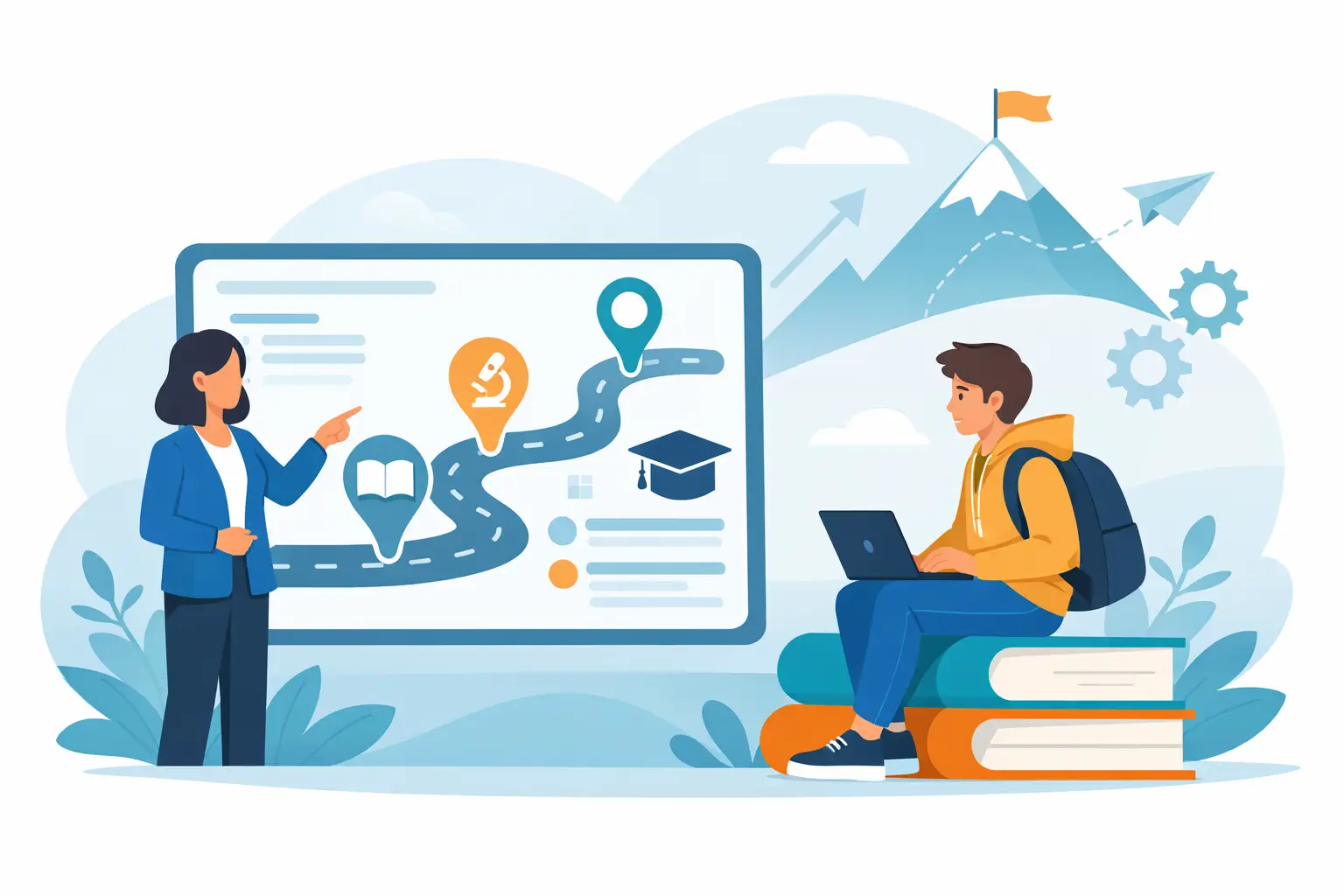
A student who studies for hours yet keeps making the same mistakes often doesn't have a motivation problem, but a path problem. Creating a personalized learning path for a student means not making them practice more, but practice smarter – with the right material, at the right pace, and at the right time.
Why a personalized learning path works
Many students receive instruction at a classroom pace, while their understanding can vary greatly by topic. For one chapter, they might only need repetition; for another, they might require extra explanation or more application questions. Those who continue to practice everything in the same way waste time and energy.
A personalized learning path makes learning more concrete. Not: "I need to get better at math," but: "I need to first understand linear equations, then be able to solve three types of problems flawlessly, and only then move on to graphs." That difference is significant. It provides clarity, reduces frustration, and makes progress visible.
For parents and schools, this is equally relevant. Extra support is often only sought when learning gaps have already accumulated. By then, it becomes more expensive, more intensive, and harder to sustain. A learning path that addresses gaps and strengths early on is usually more efficient than isolated tutoring sessions without a clear structure.
Creating a personalized learning path for a student – where to start?
The best start isn't a fancy plan, but an honest baseline assessment. You want to know what the student already masters, where the gaps are, and which learning material truly has priority now. Without this, you'll quickly work by intuition. And intuition in learning is often less reliable than it seems.
Therefore, first look at existing school material: tests, notes, assignments, readers, and chapters that will be tested soon. Precisely that own learning material is important. Generic practice platforms can be useful, but they don't always align with what's required in the classroom. A learning path works best when it's directly linked to the content the student is currently working on.
Next, you map out three things: the student's level, the time available, and the goal. That goal must be sharp. A student who has a physics test in two weeks needs a different path than a student who consistently struggles with reading comprehension or grammar. So, it depends on the context. Short-term and long-term goals require different structures.
Start with concrete learning goals
A personalized learning path stands or falls with learning goals that are small enough to track. "Getting better at English" is too broad. "Recognizing and correctly using irregular verbs in sentences" is actionable. The same applies to subjects like economics, chemistry, or history. The more concrete the goal, the easier it is to determine which practice is meaningful.
Good learning goals are linked to observable behavior. Can the student solve a problem independently? Can they explain a concept without a cheat sheet? Can they correctly structure an exam question? As soon as the answer becomes measurable, you can also adjust the path based on results rather than impressions.
This prevents a common mistake: getting stuck too long in repetition without assessment. Repetition is useful, but only if you then check whether the material has truly stuck.
Work from priority to planning
After the learning goals, the sequence follows. Not everything needs to happen at once. In fact, a student often gets stuck precisely because everything seems urgent. A smart path therefore first prioritizes topics that have the greatest impact on results.
Sometimes these are basic skills that block other components. A student who doesn't master fractions will later struggle with algebra and physics. In other cases, the test calendar is leading. Then upcoming learning material temporarily takes precedence, even if older gaps exist. This is not a weakness of the approach, but realism. A learning path must not only be didactically sound but also fit school pressures and deadlines.
Then plan in short blocks. For many secondary school students, 20 to 40 minutes per topic works better than long study sessions. Short, focused, and repeatable. Especially for subjects that evoke resistance, it helps to keep the barrier low. A path that looks perfect on paper but isn't sustained in practice has little value.
Choose practice forms that suit the student
Not every student learns in the same way, but that doesn't mean everyone needs a completely different method. Often, the difference lies mainly in the form of practice and the degree of guidance.
One student benefits from step-by-step explanations with many intermediate checks. Another prefers to quickly move to exam questions and learns by analyzing mistakes. Some students get stronger from quiz questions and active recall, others from summarizing and explaining aloud. The art is not to vary endlessly, but to choose what demonstrably helps.
That's why practicing with one's own material is so powerful. If assignments, definitions, and examples come directly from the course material, learning feels less abstract, and the chance that the student practices exactly what is needed increases. This makes a personalized learning path not only more relevant but often also cheaper than traditional tutoring, because the support is deployed much more targeted.
Creating a personalized learning path for a student with AI
Anyone who wants to practically maintain a personalized learning path for a student often encounters the same problem: it takes time. Someone has to select the material, create assignments, track progress, and adjust. For parents, this is difficult alongside work and family. For schools, it's hardly scalable if every student needs a unique approach.
This is where the added value of AI lies, working based on the student's own learning material. Not as a technical gadget, but as an efficient study tool. Course material can be converted into customized practice modules, explanations, quizzes, and repetitions. This means a student doesn't have to search for suitable practice in separate books or general apps that are just off the school level.
The big advantage is speed in personalization. Where traditional tutoring often only becomes effective after multiple sessions and at recurring costs, a digital learning path can be adapted much faster to current chapters, mistakes made, and test moments. For families seeking results without the price of weekly tutoring, that's a significant difference.
How to adjust without starting over every time
A learning path is not a fixed schedule that you create once and then check off. Good paths evolve. If a student progresses faster than expected, the pace should increase, or the practice should become more difficult. If the same mistakes recur, you need to go back to an intermediate step that isn't solid enough yet.
Therefore, look at signals weekly, not just grades. How long does the student take for assignments? Where do doubts arise? Are mistakes careless or substantive? Can the material still be applied a few days later? This kind of information often says more than a single test result.
Adjusting doesn't have to be complicated. Sometimes it's enough to break a topic into smaller parts. Sometimes the order needs to change. And sometimes it turns out that the path was too ambitious, and that less material, but better mastered, yields more. That's not a step backward. It's precisely what personalization is supposed to do.
What parents and schools often overlook
The biggest pitfall is thinking that personalization means a student must be able to work completely independently. That's not necessary. A personalized learning path can actually provide structure for students who struggle with planning, starting, or maintaining an overview. But then that path must be clear. Too many disconnected tasks still feel like chaos.
Motivation is also often overestimated as a starting point. Many students only become motivated when they notice that their approach yields results. First success, then motivation – not the other way around. That's why a path with achievable intermediate steps usually works better than a large end goal without visible progress.
For schools, something else comes into play: scalability. Personal attention is desirable, but hours are limited. Precisely for this reason, tools that enable differentiation without teachers having to manually build everything for each student are valuable. This not only saves time but also provides more consistency in guidance.
A good learning path doesn't feel heavier, but sharper
That is perhaps the most important distinction. A personalized learning path doesn't automatically add more work. If done well, it actually removes clutter. Less random practice, less repetition of familiar material, less time lost on material that doesn't align.
For a student, that means more control. For parents, it means fewer discussions about exactly what needs to be learned. For schools, it means a more realistic way to offer tailored support. And for platforms like Chappie Learn, it shows where technology truly becomes valuable: not by making learning more complicated, but by transforming existing course material into targeted, affordable, and useful support.
Ultimately, the smartest learning path is not the most extensive, but the path a student actually follows – and one that aligns a little better each week with what is needed.