
Chappie Learn: The Solution to AI Abuse in Education 🚫🎓
Many teachers and schools are very concerned about AI tools like ChatGPT. Understandably so, because students often use it to passively copy answers without actually understanding the material. This is a major pain point in modern education and drags down performance.
Chappie Learn was specifically developed to solve this. Instead of spoon-feeding answers, our AI tutor guides the student through active, pedagogical learning methods that align directly with their own textbook. This way, the student really learns to think for themselves!
Students enter their homework question and get the ready-made answer instantly. No learning process takes place, homework becomes a copy-paste task, and students fail on exams.
The AI asks Socratic, guiding questions and gives targeted hints instead of answers. Students are forced to actively apply the theory from their own book to move forward.
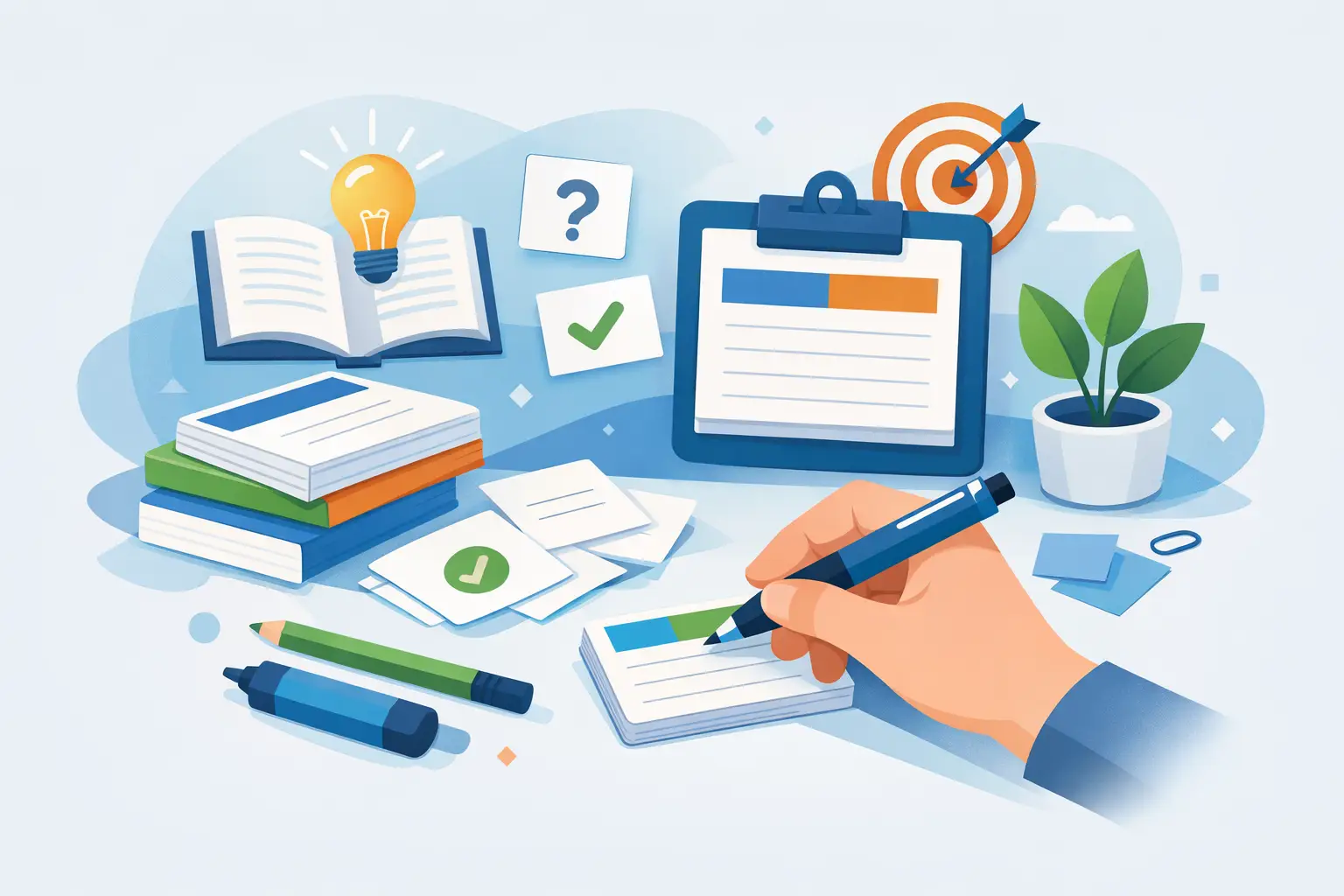
Quickly rereading everything the night before a test feels productive, but rarely yields much. Those who truly want to remember better benefit more from active recall than from passive rereading. That's why making flashcards for tests remains one of the smartest study methods – provided you build and use them correctly.
The difference isn't in the cards themselves, but in how you make them. Many students put entire paragraphs on a card, try to learn everything at once, or only start using cards when exam week has already begun. Then it feels like flashcards don't work, when the problem usually lies in the approach.
Why Making Flashcards for Tests is So Effective
Flashcards force you to retrieve knowledge without immediately seeing the answer. That sounds simple, but it's precisely that moment of searching your memory that helps information stick better. So, you're not just training what you know, but also how quickly you can recall it during a test.
There's another aspect. A good test rarely asks for recognition alone. Multiple-choice questions, open questions, and glossaries revolve around active recall, making connections, and precise formulation. Flashcards align better with this than endlessly highlighting in your textbook.
However, the same applies here: not every card is equally strong. For vocabulary and definitions, flashcards almost always work well. For complex reasoning, mathematical steps, or lengthy text analyses, you often need a combination of flashcards, practice questions, and summarizing. So, it's not a miracle cure, but an efficient foundation.
When Flashcards Are and Are Not the Best Choice
For subjects with many facts, concepts, formulas, and dates, flashcards are ideal. Think of biology, history, geography, economics, or languages. You can also use them extensively for chemistry, for example, for reactions, symbols, and definitions.
In subjects where you primarily need to apply knowledge, such as mathematics or physics, flashcards mainly help with the building blocks. You can create cards with formulas, units, definitions, and common mistakes. The actual test preparation still requires practice problems afterwards.
For text analysis, essays, or literature, flashcards are useful as a memory aid, but not sufficient as the sole method. In these cases, it's better to use them to train key concepts, argumentation structures, or stylistic devices, while also actively writing and practicing.
How to Smartly Approach Making Flashcards for Tests
Don't start with everything in your notebook. Selection is precisely the first gain. Look at learning objectives, chapter titles, bolded terms, mistakes from previous tests, and topics your teacher has emphasized. Anything that frequently reappears or remains difficult to remember deserves a card.
Then, create one card per idea. That sounds strict, but it prevents a card from turning into a mini-summary. The front should have a clear question, term, or prompt. The back should have one short answer that you could genuinely give on a test.
A weak card, for example, is: "Tell me everything about photosynthesis." That's too broad. A stronger card is: "What is the formula for photosynthesis?" or "Why is chlorophyll needed for photosynthesis?" The more specific the question, the better you can test yourself.
Also, formulate as much as possible in your own words. Copying from the book feels fast, but will cost you more time later because you haven't truly processed the answer. As soon as you can write down a concept briefly and clearly yourself, you're already learning while creating.
What Belongs on the Front – and What Doesn't
The front should prompt your brain to think. This can be a concept, a question, an image, a formula with a blank part, or a statement you need to complete. The goal is always the same: you must first recall something yourself.
What doesn't work are vague prompts. If the front only says "Chapter 3," you're not testing anything. Double questions on one card are also impractical. If you have to remember two things at once, you won't know afterwards what exactly went wrong.
For languages, you can vary with translating, conjugating, or completing a sentence. For history, cause-and-effect questions work well. For biology, functions, processes, and differences between concepts are often strong card formats. By adapting the question format to the subject, learning becomes immediately more relevant.
What Belongs on the Back
The back should be short enough to check quickly, but complete enough to be correct. One sentence is often enough. Sometimes a list of keywords works better, for example, for open questions where multiple elements are required.
Don't write out half chapters. If the answer becomes longer than a few lines, the question is usually too broad. Split it into smaller cards. That makes repetition faster and more precise.
Only add extra context if it helps prevent mistakes. For concepts that are often confused, for example, you can briefly note what the difference is. That's more useful than a long textbook answer that you won't actively recall anyway.
Digital or On Paper
On paper, flashcards work well if you want to start quickly and minimize distractions. Many students also remember well through physical writing. The disadvantage is that modifying, sorting, and planning takes more time, especially if you're studying multiple subjects simultaneously.
Digital flashcards are more efficient if you have a lot of material or want to revise smartly. You can build sets faster, mark errors, and have cards you haven't mastered yet reappear more often. For students with a busy schedule, that's often the difference between occasional studying and consistent studying.
That's precisely where the added value of a smart study approach lies. If you work with your own study material instead of generic cards from someone else, the practice aligns much better with what you truly need to know. This makes learning not only more personal but also cheaper and more effective than endlessly buying extra explanations. A platform like ChappieLearn fits perfectly into this logic: less generic practice, more training on what is actually in your chapter and test material.
The Mistake Most Students Make
Many students first make a hundred cards and only then start studying. That feels thorough, but it often leads to procrastination. It's better to create a small set per topic immediately and test it the same day. Then you'll immediately see which cards are unclear.
A second mistake is only reviewing the easy cards. That gives a pleasant feeling, but little progress. Difficult cards should be revisited more often, preferably in short rounds spread over several days.
A third mistake is looking at the answer and thinking: "Yes, I knew that." That doesn't count. Only if you can give the answer out loud or on paper before flipping the card are you truly practicing.
How to Use Flashcards in the Week Before Your Test
Ideally, start as soon as a chapter is completed, not just in exam week. But even if you start later, you can still work smartly. Divide the material into small sets per topic and plan two or three short revision sessions of ten to fifteen minutes each day. Short, repeated sessions usually work better than one long block.
Mix familiar and difficult cards together. That keeps you sharp. Then roughly sort them into three groups: I know well, I'm unsure about, I don't know yet. The middle group often receives too little attention, while that's where most of the gain lies.
Also, test yourself in reverse. If you have a concept on the front and its definition on the back, later flip it. Can you name the concept from the description? This reversal makes your knowledge more flexible, and that helps with unexpected questions on a test.
Making Flashcards for Tests Differs Slightly Per Subject
For languages, it's often about speed and precision. Keep cards short and actively practice spelling, meaning, and use in context. For history and geography, it's more about connections, periods, and causes. 'Why' questions are often stronger there than isolated facts.
For biology and chemistry, process questions work well, as long as you keep them small. For example, ask about the function of a component or the order of a process step. In economics, you can combine definitions with mini-situations, so you not only remember what a concept means but also when to apply it.
This difference per subject is precisely why standard online sets are often not enough. What you need to know depends on your method, classroom explanations, and your teacher's emphasis. The closer your flashcards are to your own material, the higher the chance that your preparation is truly effective.
When You Should Adjust Your Cards
A flashcard isn't finished just because it's written. If you get a card wrong three times, it's not always your fault. Perhaps the question is too vague, the answer too long, or the card too similar to another. Then adjust it.
That's not extra work, but a gain. Good flashcards become sharper as you study with them. The goal isn't to have many cards. The goal is to have cards that help you learn faster and perform better.
Those who use flashcards smartly study less by feeling and more by results. That brings peace of mind, especially as exam week approaches. Not because learning suddenly becomes effortless, but because you're finally working with a method that aligns with how memory truly works.
So, make your cards small, specific, and based on your own study material. Then learning will not only become more manageable but also much more effective.