
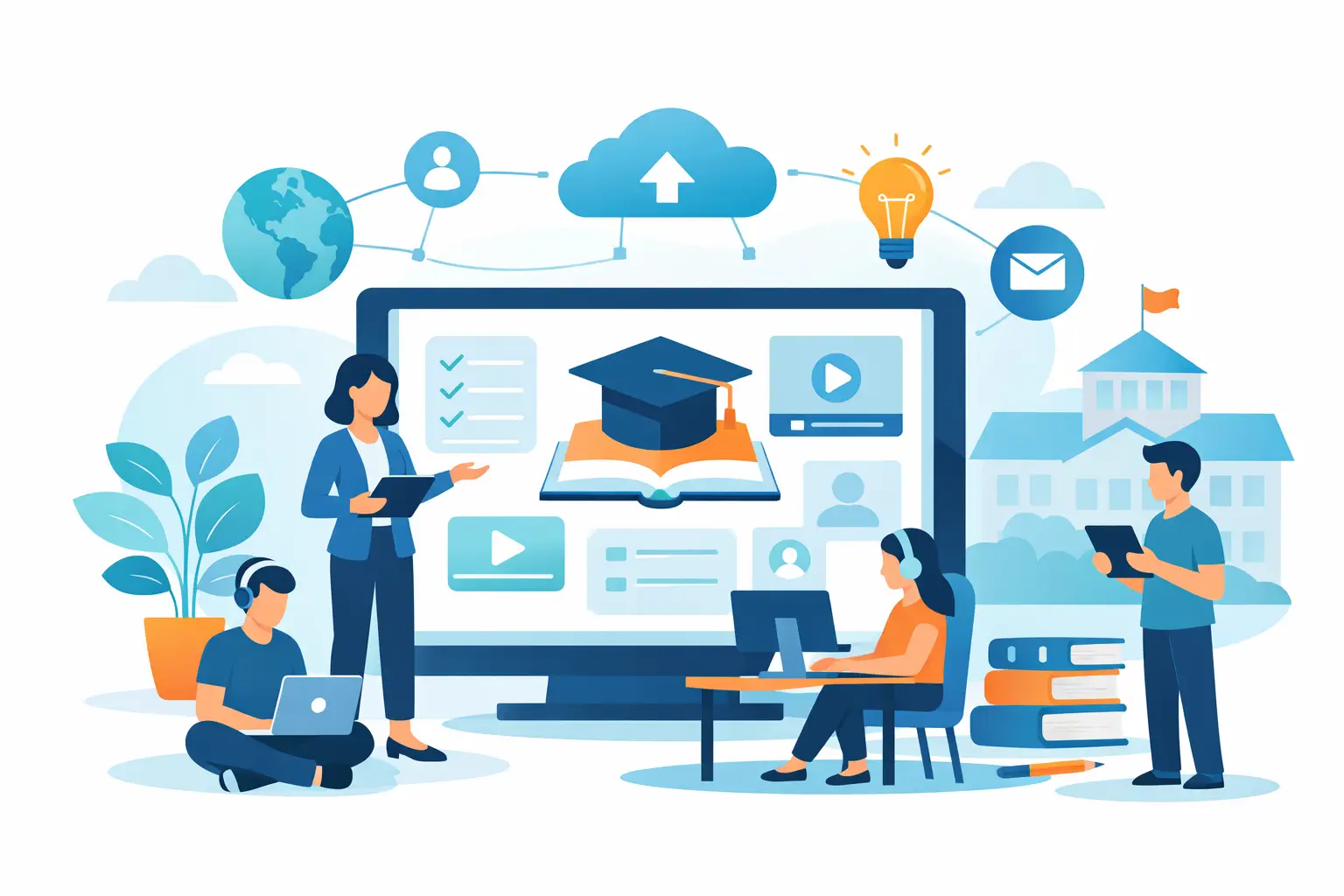
Chappie Learn: The Solution to AI Abuse in Education 🚫🎓
Many teachers and schools are very concerned about AI tools like ChatGPT. Understandably so, because students often use it to passively copy answers without actually understanding the material. This is a major pain point in modern education and drags down performance.
Chappie Learn was specifically developed to solve this. Instead of spoon-feeding answers, our AI tutor guides the student through active, pedagogical learning methods that align directly with their own textbook. This way, the student really learns to think for themselves!
Students enter their homework question and get the ready-made answer instantly. No learning process takes place, homework becomes a copy-paste task, and students fail on exams.
The AI asks Socratic, guiding questions and gives targeted hints instead of answers. Students are forced to actively apply the theory from their own book to move forward.
A school often first notices it through small signals: students struggling with the same topics, teachers having too little time for extra explanations, and parents wanting to help but not knowing how. This is precisely where a digital learning platform for schools can make a big difference. Not as just another tool on top of a busy school day, but as a practical layer that intelligently organizes explanations, practice, and progress.
The question, therefore, isn't just about which software is available. The real question is: what problem must a platform solve in the daily practice of students, teachers, and parents? Because a platform that looks good on paper can still disappoint in use if it's too generic, requires too much manual work, or doesn't sufficiently align with the curriculum.
What truly makes a digital learning platform valuable for schools
Many schools already have digital resources. An electronic learning environment, online methods, and standalone practice tools are now commonplace. Yet, a gap often remains between classroom instruction and individual support. This is precisely where the added value of a good learning platform emerges.
A strong platform not only helps in providing material but, more importantly, in personalizing guidance. That's a significant difference. Students usually don't lack content, but rather targeted help at the right moment. If a student struggles with reading comprehension, mathematical formulas, or learning for a test, standard extra practice often works less effectively than practice that directly builds on their own chapter, their own summary, or their own notes.
For schools, this is relevant because differentiation has been an ambition for years but remains difficult to scale in the classroom. Teachers cannot keep creating separate materials for every student. A platform only becomes truly interesting if it accelerates this personalization without creating additional workload.
Not more features, but better alignment with lessons
Schools often compare platforms based on features. Think of dashboards, test modules, reports, and integrations. These components are useful, but they say little about the actual educational quality. The core question is simpler: does the platform align with what students are learning today?
A student gains little from generic questions when a test on precisely one paragraph is scheduled for tomorrow. Parents also quickly see this. They are not looking for a broad educational environment with a thousand options, but a way for their child to grasp the material that matters now more quickly.
Therefore, an approach based on a school's own learning material often works better than a complete library model. When a platform can build practice questions, explanations, and study help around existing school content, learning becomes more concrete. It doesn't feel like a separate system alongside school, but as an extension of the lesson.
This is also where a modern solution distinguishes itself from traditional tutoring. Tutoring is personal, but expensive and difficult to scale. A digital platform can make this personalization much more affordable, provided the technology doesn't remain generic. Smart AI is especially valuable if it adapts to the student AND to the learning material being used.
What schools should pay attention to in practice
The choice of a platform is often influenced by procurement, IT, and ease of use. Understandably so, but educational impact must come first. A few criteria are decisive in this regard.
First, relevance is more important than volume. More assignments do not automatically mean better results. Students disengage if exercises are too broad or too simple. A good platform provides targeted support, making study time more efficient.
Secondly, ease of use weighs heavily. If teachers have to set up a lot or students first need a long explanation, usage quickly declines. Especially in secondary education, a platform should feel almost intuitive. Opening, entering or uploading material, practicing, and getting immediate feedback – that level of simplicity makes the difference.
Measurability is also important, but with nuance. Data is useful if it helps to intervene earlier. Not if it only produces pretty graphs. Schools need insight into where students are struggling, which topics require extra attention, and whether additional practice actually has an effect.
Finally, affordability plays a larger role than providers sometimes acknowledge. Budgets are under pressure. A platform that only works with high license costs or many implementation hours quickly loses ground. This is precisely why interest is growing in solutions that make supplementary guidance cheaper than structural external tutoring.
The biggest mistake: treating a platform as a distribution channel
Many digital learning environments are fundamentally built to distribute material. Handy, but limited. Uploading a PDF or setting up an assignment is not yet personalized learning support. That's precisely the bottleneck.
Students not only need access to content but active help in processing, remembering, and applying it. This means: converting explanations into practice, practice into feedback, and feedback into targeted repetition. If a platform does not support this process, it remains primarily a storage place.
For schools that want to improve study results, this is an important distinction. The gain is not in digitalization itself, but in enabling smarter learning. A platform that only broadcasts material does not achieve nearly the same effect as a platform that thinks along with the student.
Why personalization is no longer a luxury
Virtually every classroom has significant differences in pace, level, and independence. Teachers know these differences but cannot possibly guide everyone individually all the time. Personalization is therefore sometimes seen as an ideal, while in fact, it is increasingly becoming a basic requirement.
Especially for students who fall through the cracks. Not only the weakest students need extra support. Students who are performing just below their potential often benefit from targeted, customized practice. They usually manage, but with unnecessarily much time, frustration, or uncertainty.
A platform that works with a student's own learning material lowers that threshold. The step from explanation to action becomes smaller. Instead of searching for suitable extra assignments, a student can immediately get started with recognizable material. This not only increases efficiency but often also motivation.
For parents, this is at least as relevant. They want to help, but they are not subject teachers and do not always have time for daily guidance. A smart platform makes support at home more concrete and less dependent on expensive external help.
The role of AI in a digital learning platform for schools
AI still sounds abstract to some schools, but its practical value is quite clear. Not because technology takes over education, but because it makes recurring study support smarter and faster.
The best application of AI is not in general answers, but in customization. Think of automatically converting one's own summaries or chapters into practice questions, adapting difficulty based on performance, and offering extra repetition on weak points. This creates a form of digital guidance that comes close to personal tutoring, without the price and planning pressure.
Of course, here too: it depends on the implementation. AI that is detached from the school context often provides superficial help. AI that works based on existing curriculum content is much more relevant. That's precisely why schools should look beyond the term AI alone. The question is not whether it's included, but what it concretely improves.
A solution like Chappie Learn fits this development because it takes the student's own study material as its starting point. This is interesting for schools: not a generic practice environment, but support that directly aligns with what is already happening in the classroom.
Who benefits most
Not every school uses a digital platform in the same way. Some schools primarily seek support for students with learning gaps. Others want to improve study effectiveness for a broad group, or better involve parents in independent learning at home. Both approaches can work.
The greatest effect is usually seen when a platform is not introduced as a standalone project, but as a practical addition to existing educational goals. For example, in exam preparation, remediation, exam training, or independent homework. The clearer the moment of use, the greater the adoption.
It also helps if a school honestly assesses its own bottlenecks. Is the biggest challenge teacher workload, a lack of affordable extra support, or an overly generic offering for students? The right platform is not necessarily the most comprehensive system, but the system that solves the most acute problem.
The best choice is often the most practical
When choosing a platform, it's tempting to think in terms of complete digital ecosystems. However, in practice, the solution that delivers immediate results for students usually wins. Less searching, faster practice, better alignment with tests, and lower costs for extra guidance – these are benefits everyone feels immediately.
A school doesn't necessarily need more digitalization. It primarily needs better support at scale. If a platform delivers on that promise, it becomes not an extra burden, but a logical reinforcement of good education.
Anyone currently looking at a digital learning platform for schools would do well to use one simple test: does this help students better with their own learning material, without increasing the pressure on teachers or parents? If the answer to that is a clear yes, then technology finally becomes practical enough to be truly valuable.
The smartest educational choices rarely feel futuristic. They mostly feel like something that used to cost a lot of time, money, and frustration has suddenly become a lot simpler.