Chappie Learn: The Solution to AI Abuse in Education 🚫🎓
Many teachers and schools are very concerned about AI tools like ChatGPT. Understandably so, because students often use it to passively copy answers without actually understanding the material. This is a major pain point in modern education and drags down performance.
Chappie Learn was specifically developed to solve this. Instead of spoon-feeding answers, our AI tutor guides the student through active, pedagogical learning methods that align directly with their own textbook. This way, the student really learns to think for themselves!
Students enter their homework question and get the ready-made answer instantly. No learning process takes place, homework becomes a copy-paste task, and students fail on exams.
The AI asks Socratic, guiding questions and gives targeted hints instead of answers. Students are forced to actively apply the theory from their own book to move forward.
A student struggling with math at 8:30 PM gains little from a tutor who isn't available until next week. This is precisely where the choice between AI study aid versus tutoring becomes concrete. Not as an abstract debate about technology, but as a practical question: what helps faster, smarter, and more affordably to learn better?
For many parents and students, the honest answer isn't black and white. Tutoring has its strengths. So does AI. But once you look at costs, availability, and how well support aligns with a student's own learning materials, the advantage often shifts towards AI faster than many people realize.
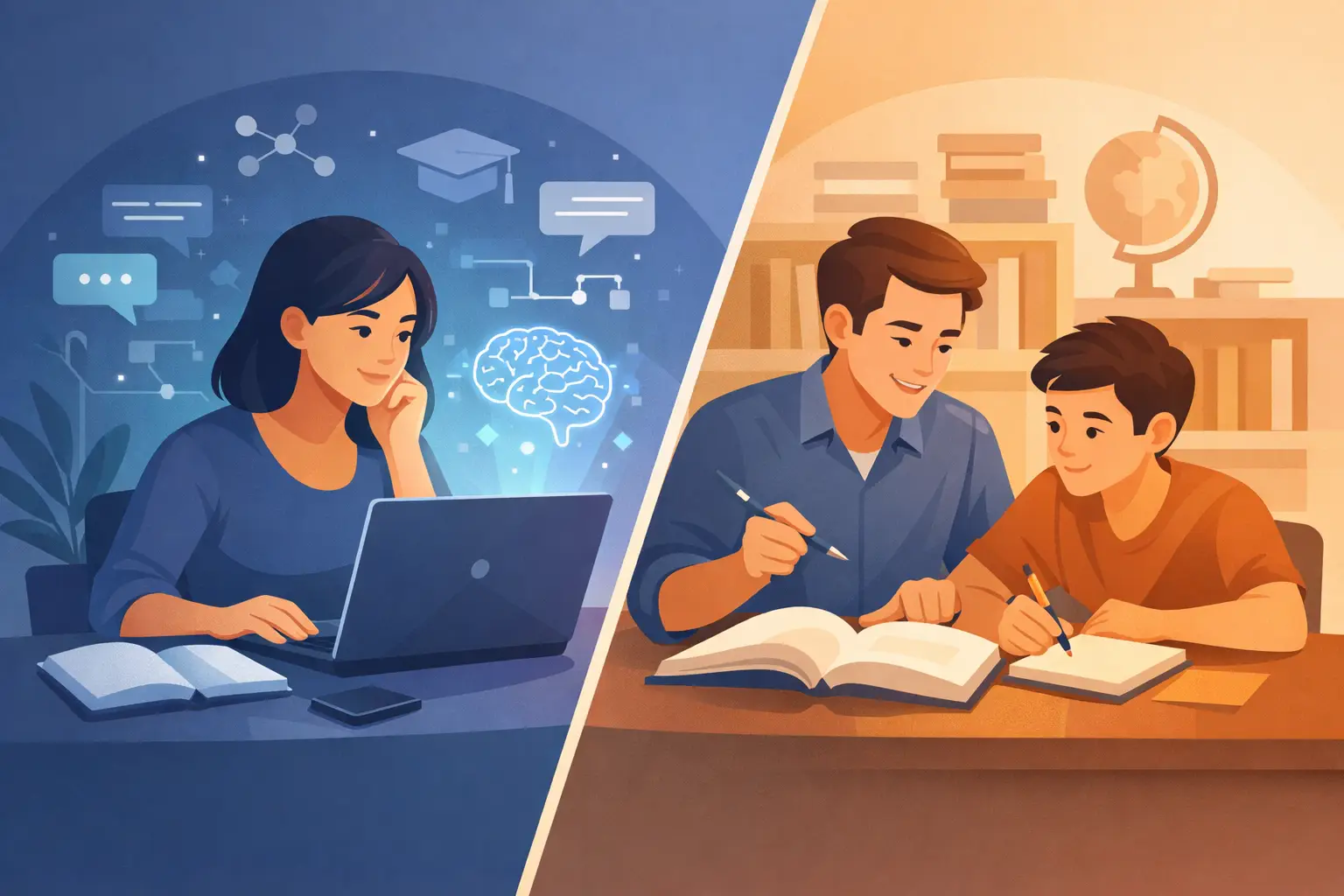
AI Study Aid vs. Tutoring: The Real Difference
Traditional tutoring usually revolves around time with a teacher. You buy attention by the hour. That can be valuable, especially if a student needs motivation, structure, or explanations of difficult thought processes. However, that's also where the limitation lies: this help is expensive, tied to schedules, and often not continuously available.
AI study aid works differently. You don't buy individual hours, but access to support that's always ready. Even more importantly: if the AI works based on the student's own chapter, their own summary, or their own test material, the help becomes much more relevant than with generic practice apps. The student then practices not with random exercises, but with precisely the content that will appear in school.
That difference is greater than it seems. Many learning problems arise not because a student "cannot learn," but because the practice doesn't align well with the material covered in class. Personal relevance is then not a luxury, but the foundation of effective study aid.
When Tutoring Is Still Strong
Tutoring is not outdated. A good teacher can do something technology cannot fully replace: sense where the uncertainty lies, probe for motivation, and sometimes help a student overcome a mental hurdle. Especially with persistent academic gaps, exam stress, or test anxiety, human contact can mean a lot.
Also for students who struggle with planning or independent work, a weekly appointment can help. The tutoring itself then provides not only substantive support but also a push for accountability.
At the same time, that's precisely why tutoring isn't always the most efficient solution. If a student primarily needs extra practice, brief explanations for questions, or repetition of course material, you quickly pay a lot of money for something that can largely be done smarter and more frequently with AI.
Where AI Study Aid Often Scores Better
AI's greatest strength lies in availability. A student doesn't have to wait until Thursday afternoon to continue. Questions arise during homework, while studying for a test, and often precisely at times when no one is immediately available. AI makes help instantly deployable.
Furthermore, personalization is the decisive point. Many digital learning tools call themselves personal, but usually mean that the level adapts. That's useful, but limited. True study aid only becomes powerful when it's tailored to the student's own material. Think of practice questions from an uploaded summary, explanations based on their own chapters, and quizzes that align with an upcoming test.
This shifts learning from general practice to targeted preparation. That saves time and increases the likelihood that studying actually yields results at school.
For parents, something else also plays a role: cost. Tutoring is almost always a recurring, relatively high expense. Especially if one hour per week proves insufficient and multiple subjects are involved, costs quickly add up. AI study aid usually offers a much lower barrier to entry and more usage opportunities. You then pay not for scarce hours, but for scalable support.
AI Study Aid vs. Tutoring for Different Students
Not every student needs the same thing. That's precisely why the question of AI study aid versus tutoring is only useful when you consider the specific situation.
The student who generally understands the material but doesn't practice enough often benefits more from AI than from tutoring. That student doesn't need weekly explanations, but repetition, quizzing, and quick feedback. AI can deliver that daily, without extra planning.
The student who primarily struggles with specific gaps can also benefit greatly from AI, provided that help aligns well with their own course material. Targeted practice modules and customized explanations make it easier to close gaps step by step.
For a student with severe demotivation, concentration problems, or strong resistance to schoolwork, tutoring can still have a clear advantage. Then it's less about the content alone and more about relationship, accountability, and behavioral support.
For many families, the smartest choice therefore lies not in "all AI" or "all tutoring," but in the question of what the biggest problem is. Is it lack of access, high costs, and insufficient practice? Then AI often wins convincingly. Is it emotional blockage or lack of structure? Then human contact might temporarily be more important.
The Pitfall of Generic AI
Not all AI study aid is automatically good. That deserves nuance. A chatbot that gives general answers without the context of the textbook, test material, or the student's level feels modern but doesn't always truly help.
Precisely for this reason, AI works particularly strongly when it converts existing learning material into personalized guidance. Then technology becomes not a separate extra layer, but an extension of what a student already needs to learn. That makes practicing more concrete, faster, and more useful.
For parents and schools, that's an important distinction. The question is not only whether AI is used, but how. A smart application saves time and increases learning outcomes. A generic application primarily adds screen time.
What Does This Mean for Parents?
Parents usually aren't looking for a technological narrative. They want to know if their child learns more independently, experiences less stress, and achieves better results without costs getting out of hand.
From that perspective, AI study aid is often more appealing than classic tutoring. Not because a teacher adds nothing, but because many daily learning problems simply don't require expensive one-on-one sessions. A student who can immediately practice with their own material, request explanations when needed, and be regularly quizzed builds routine faster.
That also changes the role of parents at home. Instead of having to quiz themselves or explain difficult material, they get a more practical system that makes the student more independent. That saves frustration on both sides.
And for Schools?
For schools, scalability is the major factor. Traditional tutoring is difficult to deploy broadly. It requires a lot of manpower, coordination, and budget. AI study aid, however, can offer a logical supplementary model, especially when students work with their own materials.
This makes additional support more accessible for more students simultaneously, without necessarily decreasing quality. In fact, if the support is well-personalized, it can align more consistently with the curriculum than external tutoring does.
For schools looking for affordable reinforcement outside of class hours, this is a serious development. Not as a gadget, but as a practical extension of education.
So What Works Better?
If you look purely at flexibility, price, and alignment with daily study needs, AI has a strong advantage. Especially for students who benefit from frequent practice, immediate feedback, and support based on their own learning materials. In that scenario, AI study aid is not just an alternative to tutoring, but often a smarter replacement.
Tutoring remains valuable in situations where human contact itself is part of the solution. Think of complex motivational issues, significant academic gaps, or students who barely start without external pressure. But that's not the standard need for everyone.
For the large middle group, something simpler applies: they don't need expensive hours, but better study help. Help that is immediately available, remains affordable, and precisely aligns with what they need to know tomorrow. That's why platforms like ChappieLearn feel so logical for modern students and parents. Not because technology itself is impressive, but because it finally makes learning more practical.
The best choice is therefore not the most traditional or the newest. It is the form of help that is most often available when a student truly needs it – and that makes schoolwork not more general, but more personal.