Chappie Learn: The Solution to AI Abuse in Education 🚫🎓
Many teachers and schools are very concerned about AI tools like ChatGPT. Understandably so, because students often use it to passively copy answers without actually understanding the material. This is a major pain point in modern education and drags down performance.
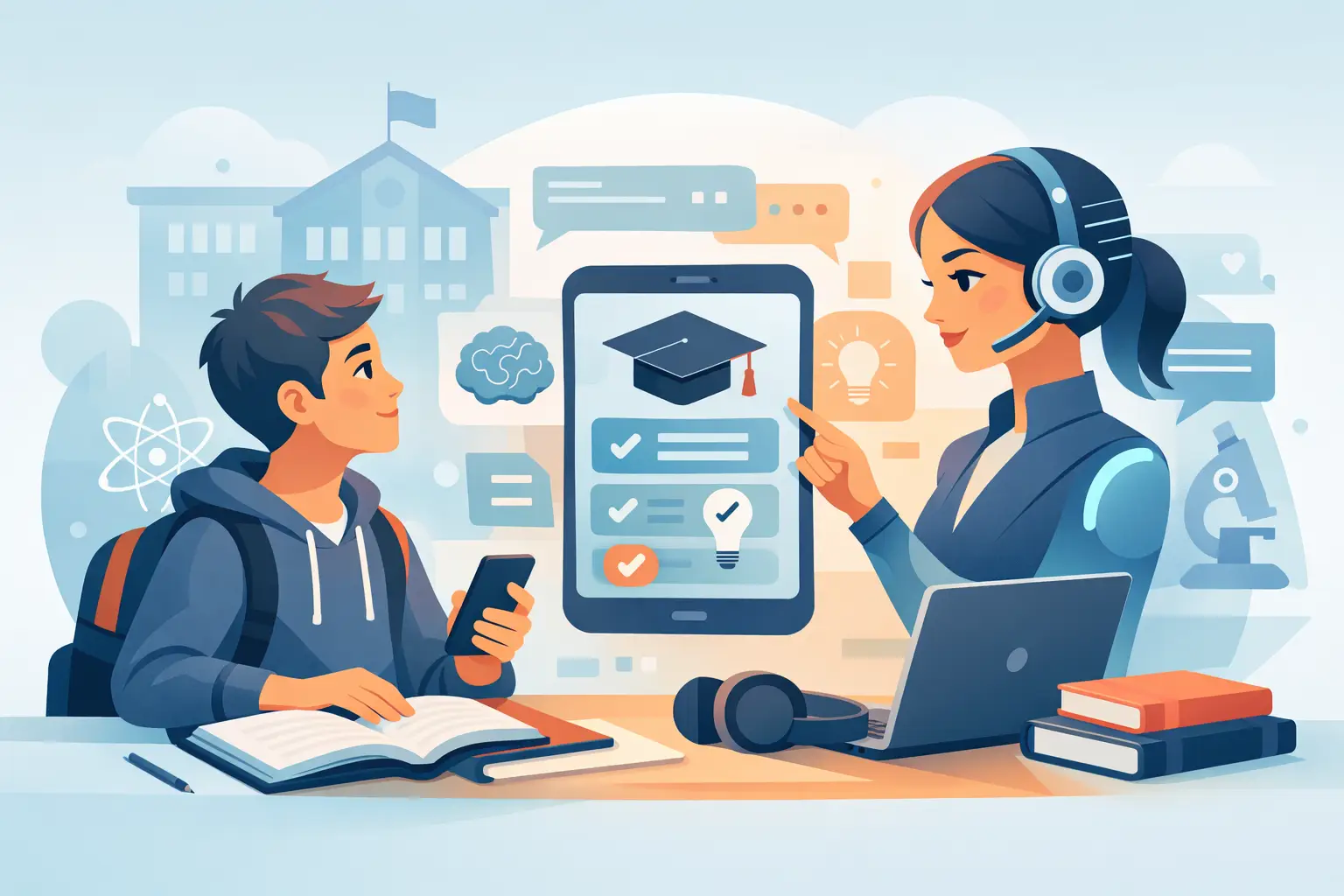
Chappie Learn was specifically developed to solve this. Instead of spoon-feeding answers, our AI tutor guides the student through active, pedagogical learning methods that align directly with their own textbook. This way, the student really learns to think for themselves!
Students enter their homework question and get the ready-made answer instantly. No learning process takes place, homework becomes a copy-paste task, and students fail on exams.
The AI asks Socratic, guiding questions and gives targeted hints instead of answers. Students are forced to actively apply the theory from their own book to move forward.
A student struggling with a summary for history at 9:30 PM won't benefit much from an expensive tutoring appointment next week. That's precisely the value of AI study aid for secondary school: help when it's needed, tailored to their own course material, and without the price tag of traditional tutoring.
For many families, that difference is significant. Regular tutoring can be effective, but it's often expensive, difficult to schedule, and dependent on the quality of a single teacher. Generic practice apps are cheaper, but for many students, they feel like extra work that doesn't align well with what's required in class tomorrow. AI can fill that gap, but only if used smartly.
Why AI Study Aid for Secondary School is Truly Relevant Now
In secondary school, subjects, deadlines, and tests quickly pile up. Students not only need to understand the material but also learn to plan, revise, and apply it. This is often where things go wrong. Not because a student is unmotivated, but because the support is too general.
A student in havo 3 gains nothing from explanations written for vwo 6. And preparing for a biology test is more successful with one's own chapters, concepts, and notes than with random online examples. Good AI study aid for secondary school therefore doesn't work independently of education, but rather alongside and on top of it. The technology must align with what a student already receives from school.
That's also why personalized support yields faster results than standard practice material. When AI generates practice questions from a student's own summary or converts difficult paragraphs into understandable explanations, learning becomes more concrete. Less searching, less distraction, more time spent on the material that matters.
What Makes Good AI Study Aid Different in Secondary School
Not every AI tool is automatically a good study aid. The difference lies in personalization. A chatbot that provides general answers can be useful for a quick explanation, but it's much less helpful during a specific exam week. Secondary school students usually benefit more from a system that works with their own books, chapters, PowerPoints, or notes.
This shifts AI from an information source to a learning partner. Instead of isolated answers, you get practice modules, quizzes, and explanations based on the material that is actually on the curriculum. This makes learning not only more efficient but also more reliable in the school context.
For parents, this is equally relevant. Many parents aren't looking for a technical solution, but simply something that helps without having to arrange tutoring every week. A platform that is available at any time and adapts to the course material fits better with how school support works today.
Where Students Immediately Notice the Benefits
The first advantage is speed. If a student gets stuck on math or economics, they don't want to spend twenty minutes searching for the right explanation first. AI can instantly convert difficult sections into simpler language or offer extra practice on precisely that topic.
The second advantage is focus. Many students lose time on everything surrounding the material: making summaries, devising questions, practicing at the right level, reviewing what went wrong before. These are precisely the tasks that AI can accelerate. Not by taking over the learning, but by making the preparation smarter.
The third advantage is repetition without boredom. Those who need to memorize vocabulary, definitions, or formulas benefit from variation. AI can present the same material in different ways, so knowledge sticks better. This is especially valuable during exam weeks, when multiple subjects demand attention simultaneously.
The Real Comparison with Traditional Tutoring
Traditional tutoring still has value. A good teacher can identify motivational problems, ask probing questions, and provide personal coaching. For some students, especially those with significant learning gaps or test anxiety, human guidance remains important.
However, there are clear disadvantages. Tutoring is often expensive, has limited availability, and is difficult to scale. Moreover, one hour per week is not always enough. Many questions arise precisely while doing homework, shortly before a test, or at times when no tutor is available.
AI approaches this differently. It's immediately available, works with current course material, and can be used much more frequently without costs continuously increasing. This makes it a more logical model for many families. Not as a luxury extra, but as a practical replacement for expensive and fragmented help.
Something similar applies to schools. Organizing extra support for large groups of students requires time, staff, and budget. A scalable digital solution can be a strong alternative, provided it aligns well with the curriculum and is easy to use.
What to Look For When Choosing an AI Solution
The most important question is simple: does the tool work with the student's own course material? If the answer is no, the help quickly becomes too general. Especially in secondary school, the level, method, and chapter order make a big difference.
Also, consider the form of support. Simply providing answers is not enough. A strong solution also helps with practicing, revising, and structuring. Think of custom quizzes, explanations in understandable language, and modules that break down a chapter into manageable sections.
Ease of use also counts heavily. If a student first has to learn a complicated system before it helps, the benefit quickly disappears. Good technology feels simple. Upload, practice, understand, continue.
Finally, the cost difference is not a detail, but a decisive factor. Many families want extra help but don't want to be tied to high monthly costs for traditional tutoring. In that case, an affordable digital solution with personal relevance is often much more appealing.
AI Works Best as a Supplement to School, Not a Detour
A common concern is that students might become less independent with AI. This concern is understandable, but it depends on how the tool is used. If AI only provides quick answers, it can reinforce lazy behavior. If AI, on the other hand, asks questions, offers practice, and adapts explanations to the student's level, independent learning is more likely to improve rather than worsen.
That distinction is important. The best AI study aid for secondary school does not replace critical thinking. It supports it. A student still needs to read, understand, apply, and correct mistakes. The difference is that this process runs more smoothly.
This also makes AI interesting for teachers and schools. Not as a competitor to the lesson, but as an extension of it. Students can continue practicing the same material outside of class, in a way that directly aligns with what was covered in the lesson. This makes extra support more consistent and sustainable.
Who This Makes a Big Difference For
Not every student has the same needs. Strong self-starters often use AI to work faster and revise more efficiently. Students who struggle with planning benefit from the structure. And those who get stuck on explanations benefit from material offered in simpler language.
For parents too, the effect is different, but often very concrete. Fewer discussions at the kitchen table, less reliance on expensive external help, and more insight into how a child actually practices. This provides peace of mind, especially during busy periods.
For schools, the gain lies primarily in scale. Personal support is valuable, but not infinitely available. A solution that converts existing course material into personalized help makes extra guidance more feasible for larger groups. This is precisely the direction in which smart education is developing.
Platforms like Chappie Learn align strongly with this, because they don't start from general content, but from the student's own material. That might seem like a small difference, but in practice, it often determines whether study aid is truly useful.
The Best Choice is Usually Not More Help, But Smarter Help
Many students don't necessarily need more hours of support. They need help that fits better. Less general, less cumbersome, and less expensive. That's why AI is gaining ground so quickly in secondary schools.
Not because technology solves everything, but because good technology does precisely what traditional support often neglects: providing immediate help, aligning with one's own material, and repeating without extra hassle. For students, this means more control. For parents, lower costs. For schools, greater reach.
So, those seeking study aid don't just need to ask if AI is smart. The better question is whether the support finally becomes as personal and practical as school always should have been.