Chappie Learn: The Solution to AI Abuse in Education 🚫🎓
Many teachers and schools are very concerned about AI tools like ChatGPT. Understandably so, because students often use it to passively copy answers without actually understanding the material. This is a major pain point in modern education and drags down performance.
Chappie Learn was specifically developed to solve this. Instead of spoon-feeding answers, our AI tutor guides the student through active, pedagogical learning methods that align directly with their own textbook. This way, the student really learns to think for themselves!
Students enter their homework question and get the ready-made answer instantly. No learning process takes place, homework becomes a copy-paste task, and students fail on exams.
The AI asks Socratic, guiding questions and gives targeted hints instead of answers. Students are forced to actively apply the theory from their own book to move forward.
A student struggling with maths often receives the same solution as a hundred other students: extra explanation, another practice sheet, perhaps a private tutor at a hefty hourly rate. This is precisely where AI in education can make a difference. Not by providing more of the same, but by tailoring learning support to what a student truly needs to know, based on their own course materials.
That sounds appealing, and often it is. But only if you remain focused on the question of where AI genuinely adds value in education. Because there's a big difference between a smart study tool and an expensive gimmick. For students, parents, and schools, it ultimately isn't about technology, but about better results with less hassle and lower costs.
What AI in education means in practice
AI in education is not a separate subject, not a robot teacher, and certainly not a miracle cure. In practice, it involves systems that can analyse learning material, create practice questions, adapt explanations, and recognise study patterns. The best applications therefore don't feel technical, but rather practical. A student uploads summaries, chapters, or notes and then receives targeted practice on the material that will be on tomorrow's test.
This is a fundamental difference from many standard learning apps. These often work with general databases or fixed sets of questions. Useful for extra practice, but less effective if a class uses its own textbook, its own schedule, or its own specific focus areas. This is precisely where AI in education becomes interesting: when it doesn't remain generic, but connects to real classroom practice.
For parents, this means less reliance on expensive, recurring private tutoring. For schools, it means a scalable form of extra support, without every student needing individual guidance from a teacher or tutor. And for students, it usually means something very simple: understanding what you don't yet master, faster.
Why personalised learning is finally becoming scalable
Personalised guidance works. Everyone in education has known this for years. The problem was never its value, but its cost and organisation. A good private tutor can make a big difference, but they are expensive, not always available, and difficult to deploy on a large scale.
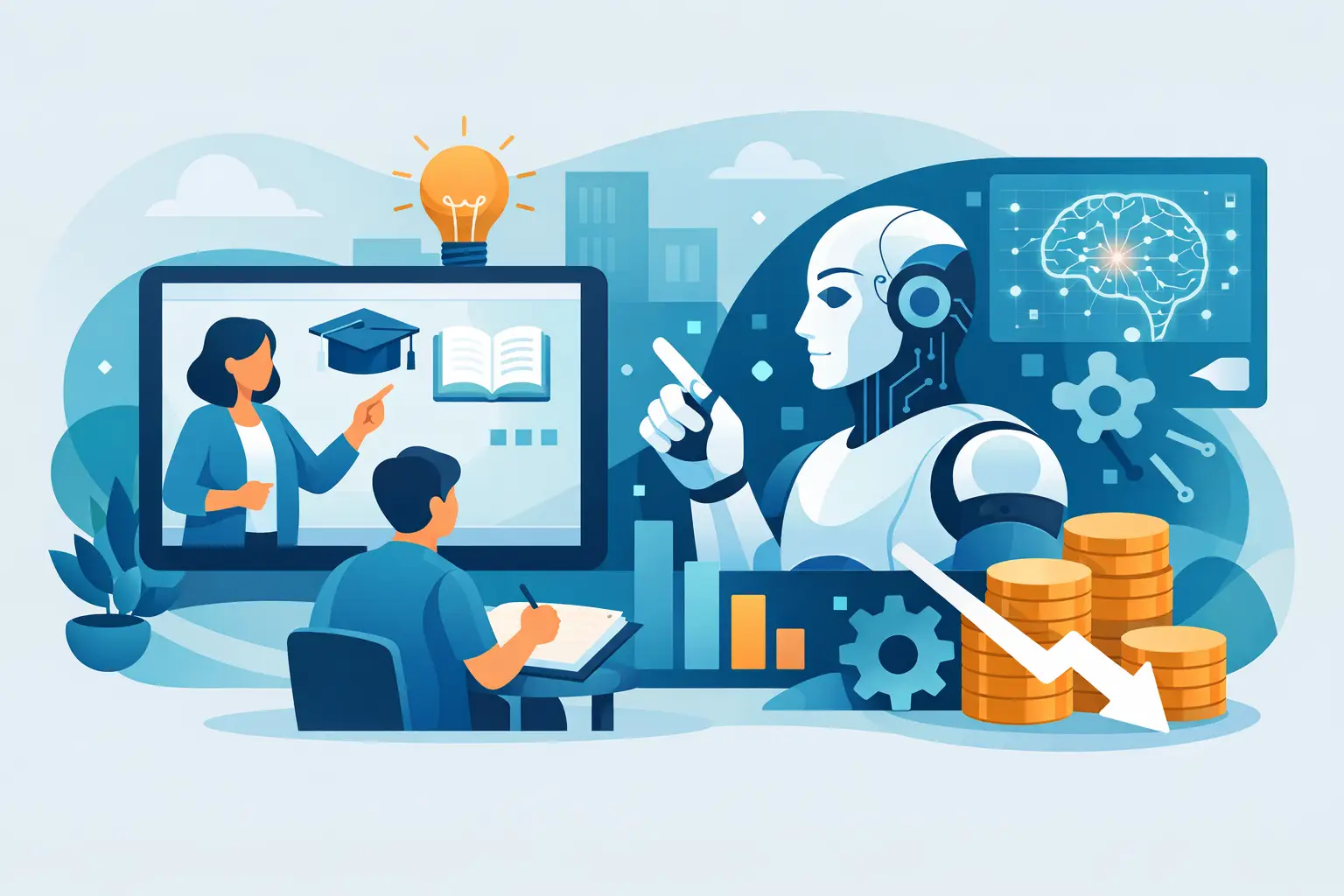
AI changes that economic model. Not because human guidance becomes redundant, but because part of the personalisation can be automated. Think of converting chapters into quizzes, identifying recurring errors, adapting repetition to the student's level, and offering explanations in smaller steps.
This creates a form of support that is closer to the student than traditional homework, but much cheaper than classic one-on-one private tutoring. This makes AI in education particularly relevant for families who want extra help but cannot or do not want to incur high costs every week.
For schools, the gain is in scale. A teacher cannot possibly create personalised practice material for thirty students every evening. A good AI system can, as long as the content is accurate and the teacher maintains control over quality. That's the real opportunity: not replacing teachers, but extending their reach.
What AI in education is truly good at
The strongest applications of AI in education are not in delivering grand visions, but in small, concrete improvements to the learning process. Three things, in particular, stand out.
Firstly, AI accelerates the translation of learning material into practice. Instead of searching for questions themselves or waiting for extra material, a student can immediately start working with their own content. This shortens the time between explanation and application.
Secondly, AI makes learning more consistent. Many students only study seriously just before a test, partly because creating good practice material takes time. If that material is automatically available, short and regular practice becomes much more realistic.
Thirdly, AI can quickly reveal where the gaps are. Not just that an answer is wrong, but also which part of the material remains weak. This helps students work more targeted and prevents them from wasting time on chapters they already master.
For a platform like Chappie Learn, this is precisely the interesting playing field: deploying AI not as a generic question engine, but as a smart layer on top of existing school material. Then studying becomes more relevant, and thus often more effective.
Where it struggles
At the same time, AI in education is not automatically good education. That sounds strict, but it's a necessary correction to much of the marketing in this market.
The first risk is superficiality. If an AI tool primarily produces quick summaries or simple multiple-choice questions, it may seem educational without truly fostering understanding. Especially in subjects where reasoning, formulation, or interpretation are central, quality is more important than speed.
The second risk is pseudo-independence. Students may feel they are doing well because they interact a lot with a tool, while they are actually mostly following hints or recognising answers. That is different from mastering something independently.
The third risk is that schools implement AI for efficiency, while pedagogical integration lags behind. This results in technology being added on top of existing workload, instead of providing relief. A teacher must know when AI helps, when human contact is needed, and how the outcomes may be used.
Therefore, the best attitude towards AI in education is not blind enthusiasm or reflexive resistance, but a sober choice. Does it demonstrably work? Does it align with the curriculum? Does it save time or money without sacrificing learning quality? These are the questions that matter.
AI in education for students, parents, and schools
For students, the value is greatest when AI directly connects to their daily reality. Not practising with random examples, but with the material from their own textbook, chapter, or teacher's slides. Then learning becomes less abstract, and extra support doesn't feel like an additional burden.
For parents, the main benefit lies in affordability and peace of mind. Many families know the pattern: backlogs accumulate, private tutoring is engaged, schedules become packed, and costs pile up. AI cannot always fully replace this, but it can significantly reduce the need for intensive and expensive help. Especially if a student primarily needs structure, repetition, and targeted practice.
For schools, the picture is a bit more nuanced. AI offers scalable support, but only if privacy, content quality, and teacher involvement are well-managed. Schools that handle this smartly use AI as a supplement to their educational model. Not as a standalone experiment, but as a practical tool that better serves both weaker and stronger students.
How schools can smartly start with AI in education
The best implementation starts small. Not with a broad program for the entire school, but with a clear problem that needs to be solved. For example, too little time for differentiation, high demand for tutoring-like support, or low engagement in independent learning.
Then choose an application that offers immediate, noticeable benefits. Personalised practice tests based on their own course materials are often more effective than abstract chat functions. The result is concrete, teacher control remains possible, and the student immediately sees the benefit.
Also important: measure something simple. Don't just look at usage, but at outcomes such as practice frequency, errors made, test preparation, or a decrease in demand for external tutoring. Without such signals, AI remains a nice story without proof.
Finally, expectations must be clear. AI will not completely solve a motivation problem, nor will it fix weak pedagogy. But it can remove friction. And that's precisely what makes a study tool valuable: fewer barriers between student and effective practice.
The coming years of AI in education
The discussion about AI in education often too quickly moves to big questions about the future of the teacher. That discussion is understandable, but for many families and schools, a more direct question is more relevant: will it help a student be better prepared for a test next week?
The market will also be judged on this. Not on impressive technology, but on usability. Tools that remain generic will quickly fade from view. Tools that make personal learning support affordable have a much stronger position.
This also means that the bar will be raised. Users expect not only speed, but also accuracy, alignment with the curriculum, and visible effect. The winners in AI in education are therefore likely not the loudest players, but the platforms that deliver the most practical value in daily study practice.
For students, parents, and schools, this is good news. Because if AI has to prove anything, it's not that it's particularly smart. It has to prove that learning can be better, cheaper, and simpler with precisely the material that matters.
The wisest choice, therefore, is not to make AI big or small, but to make it useful. As soon as a student spends less time searching, practices more at the right level, and needs less expensive help, the discussion suddenly becomes very concrete. Then AI in education is no longer about hype, but about results.